

I. Product Overview:
Under the current global trend of promoting sustainable agriculture, reducing dependence on chemical fertilizers, and advancing the “resource utilization of waste,” organic fertilizer production equipment has become a core component of modern environmentally friendly agriculture.
An organic fertilizer production line is not a single machine, but a highly integrated and rigorously engineered system designed to convert biomass waste—such as livestock manure, crop straw, municipal waste, sugar mill filter mud, and sewage sludge—into commercially valuable granular or powder organic fertilizers through biological fermentation, physical crushing, mixing and batching, mechanical granulation, and drying processes.
The complete organic fertilizer production line developed by Zhengzhou Yizheng Heavy Machinery Equipment Co., Ltd. (Zhengzhou Yizheng) integrates the latest advancements in fluid mechanics, biochemistry, and mechanical dynamics. The system is designed to meet production capacities ranging from 10,000 to 200,000 tons per year.
Its core value lies in transforming environmentally harmful waste into stabilized, harmless, and nutrient-rich fertilizer within 7–15 days through scientifically optimized process layouts.
This equipment series demonstrates strong adaptability to various raw materials. Whether dealing with high-fiber crop residues or high-moisture, high-viscosity animal manure, customized process configurations enable high granulation rates and strong particle formation.
The final product is rich in:
- Organic matter
- Humic substances
- Macro and micronutrients
making it an ideal green solution for improving soil structure and enhancing agricultural productivity.
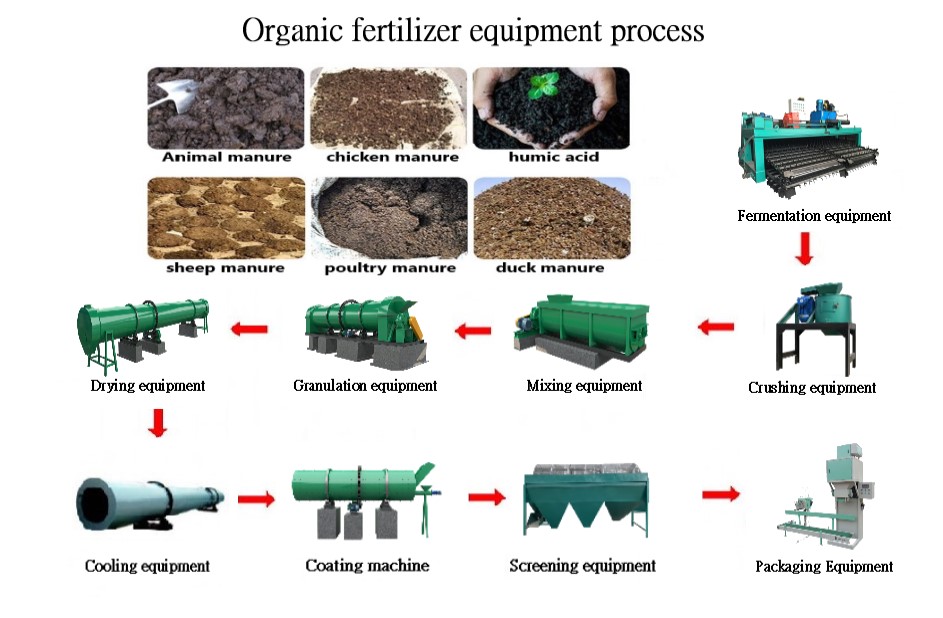
II. Working Principle:
The operation of organic fertilizer production equipment follows the technical logic of “aerobic fermentation as the foundation, mechanical granulation as the core, and automated control as the guarantee.”
The complete process can be divided into the following key stages:
(1) Aerobic Fermentation and Maturation Principle
This is the starting point of the entire system. Raw materials are mixed with microbial agents and auxiliary materials, then fed into fermentation tanks.
Trough-type or self-propelled compost turners use high-speed rotating drums to:
- Turn, crush, and aerate the material
- Provide sufficient oxygen for microbial activity
Under aerobic conditions, microorganisms rapidly decompose organic matter, generating heat and raising the temperature to 55–70°C, which effectively eliminates pathogens, insect eggs, and weed seeds.
Mechanical turning resolves issues such as uneven aeration and long fermentation cycles in traditional composting, achieving uniform decomposition and deodorization.
(2) Wet Material Crushing and Refining Principle
After fermentation, materials tend to form lumps. Semi-wet material crushers use high-speed rotating blades or chains to apply strong impact crushing.
The principle is based on kinetic energy generated by high linear velocity, reducing materials with 25%–50% moisture content to fine particles below 3–5 mm, providing a suitable size basis for granulation.
(3) Continuous Mixing and Formula Adjustment Principle
Crushed materials are fed into a horizontal mixer, where rotating spiral blades forcefully mix organic powder with added NPK nutrients or functional microbial powders.
The specially designed blade angles create a circulating flow field inside the chamber, ensuring rapid and uniform mixing of all components.
(4) Advanced Granulation Principle (Core Process)
The new organic fertilizer granulator combines the dual physical principles of stirring tooth granulation and rotary drum granulation.
Under high-speed mechanical agitation:
- Materials undergo friction, collision, and extrusion against the drum wall
- Fine particles generate surface tension in the presence of moisture
- Small particles act as nuclei and continuously grow by adhesion
In the rotary drum section, particles are further rounded into spherical shapes.
This combined “stirring tooth + rotary drum” technology achieves:
- Granulation rate above 95%
- Dense internal particle structure
(5) Heat Exchange Drying and Low-Temperature Cooling Principle
The rotary dryer operates by bringing materials into contact with hot flue gas in either co-current or counter-current flow.
Internal lifting plates increase the contact surface area, reducing moisture content to below 15%.
Subsequently, the cooler uses large volumes of ambient air to remove residual heat through convective heat exchange, preventing condensation and caking after packaging.
(6) Fine Screening and Closed-Loop Recycling Principle
Rotary screening machines separate finished products, oversized particles, and fines.
- Qualified granules proceed to packaging
- Oversized materials are crushed
- Fines and recycled materials are returned to the granulator
This forms a fully closed-loop production system.
III. Product Application:
Organic fertilizer production equipment can be configured according to different production scales and process requirements. Typical equipment includes crushers, compost turners, rotary drum granulators, dryers, screening machines, and packaging systems.
Equipment selection depends on factors such as:
- Raw material type
- Production capacity
- Investment budget
The production process generally includes:
- Raw material processing: Crushing, screening, and fermentation of manure, straw, and organic waste
- Fermentation: Microbial decomposition of organic materials
- Crushing: Size reduction for granulation
- Granulation: Formation of uniform particles
- Drying: Moisture reduction
- Screening: Particle size classification
- Packaging: Final product preparation
The system is widely applied in:
- Livestock waste treatment: Conversion of manure into commercial fertilizers
- Crop residue utilization: Processing straw and agricultural waste for soil carbon return
- Food and bio-processing byproducts: Processing distillers’ grains, filter mud, and residues
- Municipal waste management: Composting sludge and green waste
- Bio-fertilizer production: Carrier processing for functional microbial fertilizers
IV. Product Features:
Zhengzhou Yizheng’s organic fertilizer production equipment integrates industrial-grade standards with practical agricultural requirements, featuring the following advantages:
1.Wear and Corrosion Resistance, Long Service Life
Due to the acidic/alkaline and high-moisture environment of organic materials, key components are constructed using wear-resistant alloy steel or 304 stainless steel liners.
The equipment surface is treated with heavy-duty anti-corrosion coatings, extending service life by over 30% compared to conventional equipment.
2.Uniform Granules with High Strength
With advanced composite granulation technology, the produced granules are:
- Spherical and uniform
- Adjustable in size (2.0–4.5 mm)
- High in compressive strength
They meet the requirements of mechanized fertilizer application and reduce dust generation during transportation.
3.PLC Intelligent Control System
The entire production line supports full automation through centralized control systems, allowing operators to monitor:
- Fermentation temperature
- Equipment current
- Drying inlet/outlet temperatures
- Material flow
The system includes fault warning mechanisms, significantly reducing operational complexity and safety risks.
4.Low Energy Consumption and Environmental Protection
The drying system is optimized for higher thermal efficiency, reducing fuel consumption.
The production line is equipped with high-efficiency dust collection systems and optional deodorization units, ensuring compliance with environmental regulations.
5.Flexible Configuration and Modular Design
To accommodate different plant layouts, the system adopts modular design, supporting:
- Linear
- L-shaped
- Dual-line configurations
For customers with limited budgets, powder fertilizer production can be implemented first, with future upgrades to granulated fertilizer production, offering strong scalability.
6.Conclusion
Organic fertilizer production equipment is not merely a combination of machinery, but a complete solution for agricultural waste resource utilization.
It effectively addresses four major challenges in organic fertilizer production:
- Incomplete fermentation
- Difficult granulation
- Low productivity
- Equipment corrosion
It is an ideal solution for promoting green agricultural cycles and high-quality fertilizer production.
For more inquiries or more information, please contact:
Sales Department / Tina Tian
+86 – 15538237222
Zhengzhou Yizheng Heavy Machinery Equipment Co., Ltd
Email: tianyaqiong@yz-mac.cn
Website: www.yz-mac.com
Post time: Apr-21-2026