

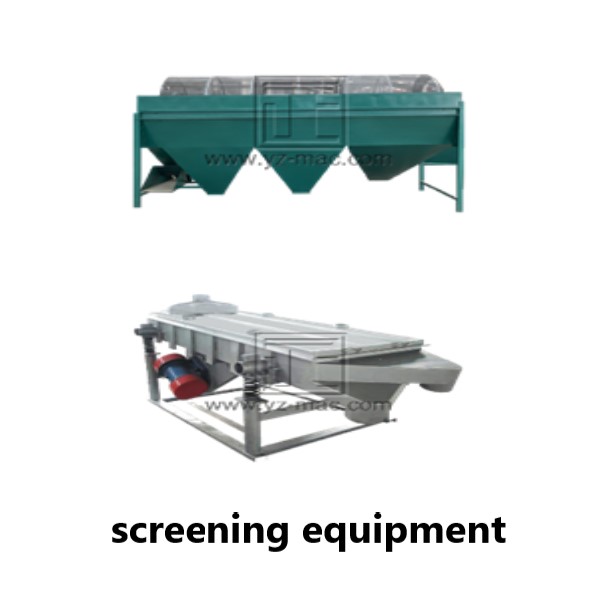
Screening equipment is used to classify fertilizer materials, separating raw materials into different particle-size ranges to meet various production requirements. It is widely applied in the chemical, food, fertilizer, metallurgy, building materials, and ceramics industries. Common screening machines include vibrating screens, rotary screens, and linear screens.
I. Product Overview:
Fertilizer screening equipment is a crucial processing machine used for particle-size grading, impurity removal, and product uniformity optimization of granular fertilizers. It is widely applied in organic fertilizer, compound fertilizer, bio-organic fertilizer, inorganic granules, feed pellets, and chemical granules. As a key process in fertilizer production lines, its performance directly affects final product quality.
With increasing industry requirements for granule roundness, size uniformity, and product appearance, screening machines have evolved from traditional single-layer mechanical screens to multi-layer precision mesh systems. Modern screening technologies integrate vibration, centrifugal separation, drum rotation, and airflow classification to significantly improve screening efficiency, grading accuracy, and equipment stability. Selecting an appropriate screening machine not only enhances overall production capacity but also reduces the recycle rate, lowers energy consumption, and elevates the market value of fertilizer products.
Modern fertilizer screening equipment features simple structure, easy maintenance, high throughput, and stable screening performance. It can be customized based on specific material characteristics and process needs, including mesh material, number of layers, aperture size, vibration intensity, and feeding configuration, enabling optimal compatibility with different fertilizer types and hardness levels.
II. Working Principle:
The working principle of fertilizer screening equipment is based on the physical mechanism in which particles are subjected to vibration or rotation on the screen surface, enabling automatic separation according to particle size. While the mechanisms vary across equipment types, the general process is as follows:
In vibrating screens, an eccentric block motor generates excitation force that drives the screen box to vibrate continuously. Materials move forward in a jumping motion and are separated through the screen apertures under the combined effect of gravity and vibration. Large particles remain on the upper layer, medium particles fall to intermediate layers, and fine particles pass through to lower layers.
A rotary drum screen uses a slow-rotating cylindrical screen to lift materials and allow them to fall by gravity. Separation occurs as particles pass through the apertures during rotation. The long screen surface provides gentle and stable screening, making it ideal for high-moisture or easily agglomerated materials such as organic fertilizers.
3. Combined Screening and Air Classification
Some systems integrate airflow to remove lightweight impurities while granular materials are further graded according to particle size and density. This improves screening precision and product purity.
4. Multi-Layer Screening Technology
Multi-layer screen decks enable simultaneous grading into 2–4 particle-size ranges, reducing recycle material and improving product uniformity—commonly used in modern fertilizer production lines.
The core of screening performance lies in the **screen mesh design, excitation method, and material movement trajectory**, all of which determine efficiency, throughput, and granule consistency.
III. Product Applications:
Fertilizer screening equipment has broad application across virtually all powder and granular materials requiring particle-size grading or quality enhancement.
1. Organic Fertilizer Production
Used for screening fermented granules and final granulated products. Removes oversized lumps and fines to improve product appearance and consistency.
Applied after extrusion granulation, rotary granulation, or spray granulation to classify NPK, nitrogen, phosphate, and potash fertilizers.
3. Bio-organic and Microbial Fertilizers
Gentle screening avoids particle breakage while ensuring uniform granule size.
4. Agricultural Mineral Materials
Such as phosphate powder, potash powder, humic acid granules, etc.
5. Feed and Chemical Industries
Suitable for pellet feed, chemical granules, and plastic granules.
6. Secondary Screening After Crushing
Used to remove impurities or fines after milling, reducing load on downstream processes.
Given variations in raw material characteristics such as moisture, hardness, and particle shape, screening systems must be customized through adjustments to mesh aperture, number of layers, vibration force, drum inclination, and more.
IV. Product Features:
Fertilizer screening equipment offers the following key advantages:
1. High Screening Efficiency and Large Capacity
Modern systems with optimized vibration dynamics and long screen decks maintain high screening efficiency. Medium to large fertilizer plants may achieve processing capacities of **5–25 tons per hour**, supporting continuous large-scale production.
2. Robust Structure and Stable Operation
The screen box, frame, and support structure use reinforced steel plates and are dynamically balanced to ensure stable amplitude and low failure rates during long-term operation.
3. Quick and Easy Mesh Replacement
Modular mesh design supports stainless steel mesh, manganese steel mesh, perforated plates, and other materials suitable for wet, agglomerated, or hard particles. Screen replacement is fast, reducing downtime.
4. Multi-Layer Grading for Multiple Particle Sizes
With 2–4 screen layers, the equipment simultaneously outputs large, medium, and small granules. This improves particle-size consistency, reduces recycle material, and increases packaging efficiency.
5. Customizable Design Options
Customizable parameters include:
* Mesh aperture
* Vibration force
* Number of layers
* Feeding/discharge configuration
* Round, square, or drum structures
* Anti-clogging devices
* Air-cooling or water-cooling systems
Ensures full compatibility with different fertilizer formulations.
6. Low Noise and Good Energy Efficiency
Equipped with high-efficiency motors and optimized mechanical structure to minimize energy consumption. Suitable for factories with strict environmental requirements.
7. Easy Maintenance and Long Service Life
High-strength materials are used in key components such as bearings, exciters, and connectors. Screen mesh has long durability, and routine maintenance is simple, significantly reducing operational costs.
8. Strong Adaptability and Anti-Clogging Performance
Suitable for high-moisture organic fertilizers, bio-fertilizers, fragile granules, and other challenging materials. Can be integrated with crushers, granulators, and dryers to form a stable production workflow.
For more inquiries or more information, please contact:
Sales Department / Tina Tian
+86 – 15538237222
Zhengzhou Yizheng Heavy Machinery Equipment Co., Ltd
Email: tianyaqiong@yz-mac.cn
Website: www.yz-mac.com
Post time: Nov-17-2025