

Modern organic fertilizer production is an efficient industrial system that converts livestock manure, agricultural waste, municipal solid waste, and other organic resources into valuable products through harmless treatment and resource utilization. Zhengzhou Yizheng Heavy Machinery Equipment Co., Ltd. specializes in fertilizer equipment and fertilizer engineering, providing complete organic fertilizer production line solutions that comply with international standards.
The complete organic fertilizer production process covers a continuous industrial manufacturing procedure from raw material intake and biological fermentation to final product packaging. The production process of organic fertilizer can generally be divided into several stages: raw material processing, fermentation, compression molding, drying, screening, and packaging.
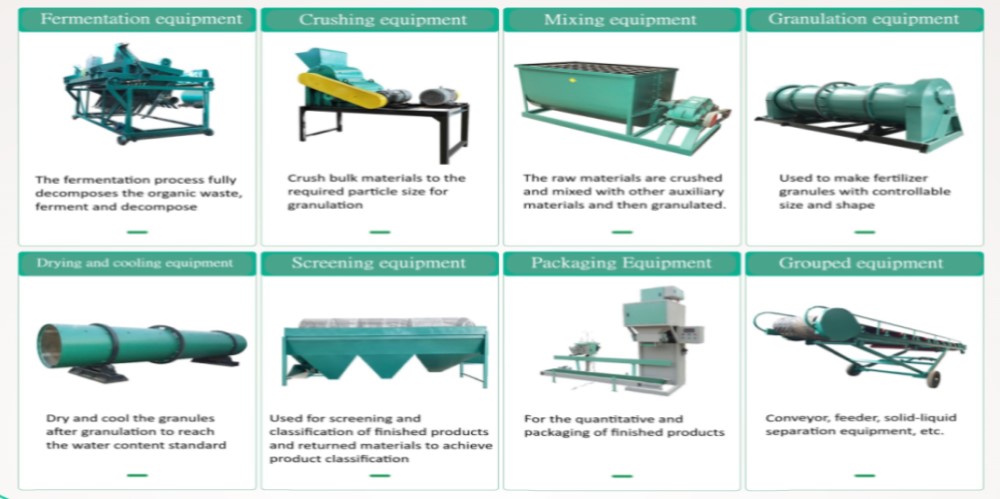
I. Fermentation & Compost Turning Section
This is the foundation and the core harmless treatment stage of the entire organic fertilizer production process.
- Material Preparation:
Collected organic raw materials such as livestock and poultry manure are initially adjusted for moisture content and carbon-to-nitrogen ratio (C/N ratio), with moisture typically controlled between 50% and 60%.
- High-Temperature Compost Fermentation:
Specialized windrow compost turners or groove-type compost turners are used to periodically turn the materials, allowing air to enter the compost pile and promoting rapid proliferation of aerobic microorganisms. During the fermentation process, the internal temperature of the pile can rise to 55°C–65°C and remain at that level for several days, thoroughly eliminating pathogens, parasite eggs, and weed seeds while completing deodorization and preliminary decomposition of the material.
II. Semi-Wet Material Crushing Section
Organic materials after fermentation often contain agglomerates of varying sizes and cannot be directly granulated; therefore, further refinement is required.
- High-Efficiency Crushing:
The material is conveyed into a semi-wet material crusher via a conveyor. This equipment is specifically designed for high-moisture fermented materials and features a high-strength wear-resistant rotor capable of crushing organic clumps into a fineness suitable for granulation (typically above 40 mesh) without wall adhesion or blockage.
III. Dynamic Batching & Mixing Section
To ensure balanced nutrient content and meet specific crop requirements for nitrogen (N), phosphorus (P), potassium (K), and trace elements, precise proportioning is essential.
- Dynamic Batching System:
The crushed organic base material, together with additional inorganic nutrients (such as urea, monoammonium phosphate, potassium chloride, etc.) and trace elements, enters the dynamic batching system according to a predetermined formula for continuous and precise static or dynamic weighing and metering.
- Uniform Mixing:
The metered materials are then fed into a horizontal mixer or a twin-shaft high-efficiency mixer. Driven by powerful mixing blades, all components achieve a highly uniform molecular-level blend within a very short period, providing a consistent feedstock for subsequent granulation.
IV. Advanced Granulation Section
Granulation is the core process for shaping organic fertilizer and enhancing both product appearance and commercial value.
- Drum and Stirring-Tooth Combined Granulation:
The uniformly mixed material is conveyed to a new-type organic fertilizer granulator (such as a drum granulator or stirring-tooth granulator). Under the combined action of high-speed rotating stirring teeth and the centrifugal rolling motion of the drum, materials rapidly aggregate into granules through surface tension and adhesive forces between particles. This advanced granulation process achieves a high granulation rate (typically exceeding 95%), excellent particle density, and a uniform spherical shape.
Freshly granulated fertilizer particles contain relatively high moisture content and have low mechanical strength, making dehydration and cooling essential.
- Rotary Dryer:
Materials are transported via conveyor to the upper feed inlet at the front end of the dryer. Inside the dryer, lifting plates arranged in a staggered pattern continuously lift and scatter the granules while the drum rotates, enabling thorough heat exchange with hot air generated by the hot air furnace. After drying, the material exits through the lower discharge outlet at the tail end and is transferred onto a conveyor belt. At this stage, the moisture content of the granules is significantly reduced.
- Rotary Cooler:
The dried high-temperature granules are immediately conveyed into the upper feed inlet at the front end of the cooler. The cooler introduces ambient air to perform forced convective cooling of the fertilizer granules. After cooling, the material is discharged through the lower outlet at the tail end onto a conveyor belt. Rapid cooling effectively removes residual heat, allowing the granules to quickly reach ambient temperature, significantly improving particle hardness and preventing caking and moisture absorption during storage.
After cooling, fertilizer granules may still vary in size. Strict particle size classification is therefore required to ensure uniform product specifications.
- Rotary Screener:
Material is conveyed to the upper feed inlet of the screening machine. Through combinations of screens with different mesh sizes, the material is accurately separated into:
Qualified Granules:
Directly transferred to the finished product section.
Over-Size Particles:
Discharged through the lower outlet and returned via belt conveyor to the crushing section for reprocessing.
Fine Particles:
Similarly discharged and directed back to the granulation section as seed material, achieving a zero-waste closed-loop production process throughout the entire production line.
VII. Automatic Packaging Section
This is the final stage of the fertilizer production line and directly affects product logistics and storage efficiency.
- Quantitative Packaging:
Qualified organic fertilizer granules enter the packaging storage hopper and are subsequently fed into an automatic quantitative packaging machine. Through a PLC-based microcomputer central control unit, the packaging machine performs dual-speed feeding and precision weighing, accurately filling fertilizer into packaging bags. The bag opening is then guided to an automatic sewing and sealing system, producing neatly arranged, standardized bagged organic fertilizer products ready for warehousing or shipment.
The above represents the general production process for organic fertilizer. Specific process configurations and equipment selection should be adjusted and optimized according to different product requirements and production capacities.
For more inquiries or more information, please contact:
Sales Department / Tina Tian
+86 – 15538237222
Zhengzhou Yizheng Heavy Machinery Equipment Co., Ltd
Email: tianyaqiong@yz-mac.cn
Website: www.yz-mac.com
Post time: Jun-01-2026