

With the rapid development of green agriculture, environmental management, and the circular economy, investing in an organic fertilizer processing plant has become an important strategic option for agricultural enterprises, livestock and poultry farming groups, and environmental engineering companies. During project planning and equipment procurement, the price of organic fertilizer processing equipment is naturally one of the primary concerns for investors.
Organic fertilizer processing equipment is not a single standardized commodity. Its price depends on multiple factors, including production capacity, raw material characteristics, process configuration, automation level, equipment materials, heat source, and environmental protection requirements.
Zhengzhou Yizheng Heavy Machinery Equipment Co., Ltd. is a professional manufacturer of fertilizer machinery and complete fertilizer production lines. With extensive experience in equipment manufacturing and fertilizer engineering, the company provides customers worldwide with cost-effective organic fertilizer processing equipment, customized production lines, and turnkey project solutions.
I. Product Overview
A complete organic fertilizer processing line integrates biological fermentation, material handling, mechanical processing, thermal drying, cooling, screening, automatic weighing, and process control technologies.
Depending on the selected production process, a complete line may include:
- Fermentation and compost turning equipment
- Horizontal or double-shaft mixers
- Organic fertilizer granulators
- Belt or bucket conveying systems
- Dust collection and exhaust gas treatment systems
- Automatic weighing and packaging machines
- PLC/HMI control systems
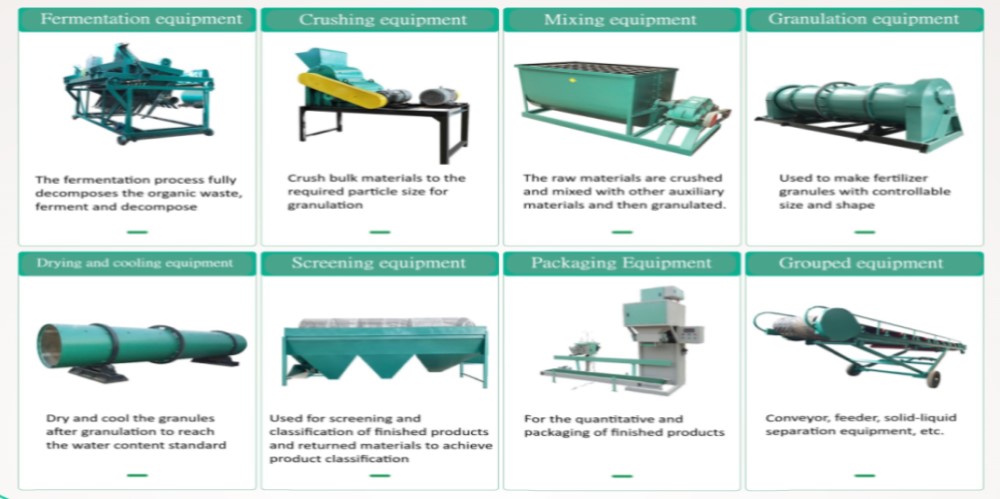
In actual projects, the price of an organic fertilizer processing line is primarily determined by four major factors.
1. Production Capacity
Production capacity is one of the most important factors affecting equipment price.
A small production line with an annual capacity of approximately 10,000 tons requires significantly smaller crushers, mixers, granulators, dryers, coolers, and conveying systems than a large industrial line with an annual capacity of 100,000–200,000 tons.
As capacity increases, equipment diameter, length, structural strength, motor power, conveying capacity, and auxiliary system requirements also increase.
2. Process Configuration and Main Equipment
Different fertilizer manufacturing processes require different equipment combinations.
For example, an organic fertilizer powder production line may require only fermentation, crushing, screening, and packaging equipment, while a complete granular organic fertilizer line may additionally require:
Mixing → Granulation → Drying → Cooling → Screening → Coating → Packaging
Granulation technology also influences the total investment. Depending on the raw material and finished-product requirements, the production line may use a disc granulator, stirring-tooth granulator, rotary drum granulator, extrusion granulator, or another suitable granulation system.
Therefore, equipment price should always be evaluated according to the complete process configuration, rather than simply comparing the price of individual machines.
3. Automation and Control System
Automation level has a significant impact on equipment investment.
A basic production line may use centralized electrical cabinet control, while more advanced lines can incorporate:
- PLC control
- HMI touchscreen operation
- Variable-frequency drives
- Automatic batching
- Automatic weighing
- Equipment interlocking
- Motor load monitoring
- Temperature monitoring
- Alarm and fault indication
- Production data recording
- Remote monitoring options
Higher automation generally increases the initial investment but can reduce labor requirements, improve process consistency, and simplify production management.
4. Materials and Corrosion Protection
Organic fertilizer materials may contain relatively high moisture and can be sticky, abrasive, or mildly corrosive.
Equipment construction can therefore be customized using carbon steel, stainless steel, wear-resistant alloys, corrosion-resistant coatings, or anti-stick liners according to the actual material characteristics.
Using SUS304 stainless steel or specialized wear-resistant materials for material-contact components will normally increase the initial equipment price, but may reduce corrosion, wear, and long-term maintenance requirements.
II. Working Principle and Cost Factors
Understanding the complete organic fertilizer production process helps investors determine which equipment is necessary and where the major investment is concentrated.
1. Aerobic Fermentation
Organic raw materials such as livestock and poultry manure are first adjusted to suitable moisture and C/N conditions before aerobic fermentation.
Depending on the production scale and fermentation method, the system may use groove-type compost turners, crawler compost turners, or vertical aerobic fermentation equipment.
Major price factors include:
- Working width
- Turning depth
- Processing capacity
- Traveling mechanism
- Aeration system
- Automation level
2. Crushing
After fermentation, the material may contain agglomerates, fibers, and irregular particles.
A semi-wet material crusher can be used to reduce the material to a suitable particle size for subsequent mixing or granulation.
Major price factors include:
- Processing capacity
- Rotor configuration
- Motor power
- Wear-resistant components
- Material-contact construction
3. Batching and Mixing
Organic material, NPK nutrients, trace elements, or other additives can be proportioned according to the required fertilizer formulation.
Automatic batching systems use weighing sensors and controlled feeding devices to meter different materials before they enter the mixer.
Major price factors include:
- Number of batching bins
- Weighing accuracy
- Load-cell configuration
- Feeding system
- Mixer capacity
- Automation level
4. Granulation
The mixed material enters the selected granulator to form fertilizer particles.
Depending on the raw material characteristics and product specifications, equipment such as a stirring-tooth granulator, disc granulator, rotary drum granulator, or extrusion granulator may be selected.
Granulation equipment is one of the core machines in a granular organic fertilizer production line.
Major price factors include:
- Production capacity
- Granulation method
- Main structure
- Drive system
- Wear-resistant components
- Required particle specifications
Actual granulation performance depends on raw material composition, moisture, particle size, formulation, operating parameters, and equipment configuration.
5. Drying and Cooling
Freshly granulated fertilizer normally contains relatively high moisture and may have insufficient mechanical strength.
The material is conveyed into the upper inlet at the front end of the rotary dryer. As the drum rotates, internal lifting flights continuously lift and disperse the material, creating a material curtain that exchanges heat with the hot air stream. The dried material is discharged through the lower outlet at the rear end onto the downstream conveyor.
The hot fertilizer particles are subsequently conveyed into the upper inlet at the front end of the cooler. Ambient or conditioned cooling air removes residual heat, and the cooled material is discharged from the lower outlet at the rear end onto the downstream conveyor.
Major price factors include:
- Drum diameter and length
- Steel plate thickness
- Internal lifting-flight design
- Drive system
- Heat source
- Burner or hot-air furnace
- Induced-draft system
- Dust collection system
Because drying and cooling involve large rotating equipment and auxiliary thermal systems, this section can represent a substantial portion of the total production-line investment.
6. Screening and Material Recycling
After cooling, fertilizer particles are conveyed into the screening machine through the upper inlet.
Screening separates the material into qualified product, oversized particles, and undersized particles. Oversized particles can be returned for crushing, while undersized particles can be recycled to the granulation process.
This closed-loop arrangement helps improve raw material utilization and maintain consistent finished-product particle size.
7. Coating and Automatic Packaging
Depending on the finished-product requirements, qualified fertilizer particles may enter a coating machine for anti-caking or surface treatment.
The finished fertilizer is then transferred to an automatic quantitative packaging machine for weighing, filling, bag clamping, sewing, or sealing.
Packaging systems can be configured for different bag sizes and automation requirements.
III. Applications
The final price of organic fertilizer processing equipment is closely related to the raw materials and intended application.
Livestock and Poultry Manure
Typical materials include chicken manure, pig manure, cattle manure, and sheep manure.
Different manure types have different moisture, fiber, salt content, and handling characteristics. Therefore, fermentation, crushing, drying, deodorization, and corrosion-protection requirements should be determined according to the actual raw material.
Agricultural and Forestry Residues
Typical materials include:
- Crop straw
- Rice husks
- Peanut shells
- Mushroom residues
- Bagasse
- Distillers’ grains
Low-density or fibrous materials may require additional shredding, crushing, or premixing equipment before fermentation.
Municipal Sludge and Organic Waste
Sludge and other municipal organic wastes may require additional pretreatment, dewatering, impurity separation, odor control, and environmental protection systems.
The suitability of these materials for fertilizer production should also be determined according to local regulations and raw-material testing requirements.
Bio-Organic Fertilizer
Bio-organic fertilizer containing functional microorganisms requires particular attention to temperature and moisture conditions.
Where microbial viability must be maintained, the process should be designed to avoid exposing sensitive microorganisms to unsuitable temperatures. Microbial inoculation may therefore be arranged after high-temperature processing stages where appropriate.
IV. Product Features
1. Direct Manufacturer and Integrated Engineering
Zhengzhou Yizheng Heavy Machinery provides equipment selection, process design, manufacturing, installation guidance, commissioning support, and operator training according to project requirements.
An integrated solution can reduce coordination problems between equipment from multiple suppliers.
2. Cost-Effective Equipment Configuration
Rather than simply selecting the lowest-priced machine, equipment can be configured according to actual raw material properties, capacity, product specifications, operating hours, and investment budget.
This approach helps avoid both unnecessary over-configuration and insufficient equipment capacity.
3. Modular Production-Line Design
The production line can be constructed using modular equipment sections.
For projects with limited initial investment, certain automation or downstream processing modules may be added or upgraded later, provided that expansion requirements are considered during the initial engineering design.
4. Wear- and Corrosion-Resistant Options
Material-contact components can be manufactured or protected using suitable wear-resistant or corrosion-resistant materials according to operating conditions.
This helps reduce maintenance frequency and extends the service life of critical components.
5. Energy-Efficient System Design
Drying capacity, airflow, heat source, insulation, and material residence time can be engineered according to actual material moisture and throughput.
Correct thermal-system sizing is important because both undersized and oversized drying systems can increase operating costs.
V. Reference Technical Parameters and Equipment Investment Budget
The following figures are intended only for preliminary project planning. Actual equipment selection and quotation should be based on raw material characteristics, required finished product, operating hours, site conditions, environmental requirements, and the final process flow.
|
Technical / Budget Item |
10,000 t/year |
30,000 t/year |
50,000 t/year |
100,000 t/year |
200,000 t/year |
|
Reference Capacity (t/h) |
1.5–2.0 |
4.0–5.0 |
7.0–8.0 |
14.0–16.0 |
28.0–30.0 |
|
Reference Installed Power (kW) |
120–160 |
280–350 |
450–580 |
850–1,100 |
1,600–2,100 |
|
Reference Plant Area (m²) |
800–1,200 |
2,000–3,000 |
3,500–5,000 |
7,000–10,000 |
15,000–20,000 |
|
Typical Control Configuration |
Centralized Control / PLC |
PLC + HMI |
Distributed PLC |
Distributed PLC |
Distributed PLC |
|
Typical Granulation Configuration |
Disc / Stirring-Tooth |
Stirring-Tooth |
Combined System |
High-Capacity Granulation System |
Multiple Granulation Units |
|
Indicative Equipment Budget (RMB) |
150,000–350,000 |
450,000–850,000 |
900,000–1.60 million |
2.20–3.80 million |
4.50–7.50 million |
Important: The above budget ranges are indicative only and should not be regarded as a fixed quotation. Actual prices depend on equipment configuration, material of construction, automation level, heat source, environmental protection system, electrical component brands, installation scope, and other project-specific requirements. Civil works, buildings, utilities, freight, taxes, installation, and other costs should be confirmed separately according to the scope of supply.
How Should Organic Fertilizer Equipment Prices Be Evaluated?
The purchase price alone does not determine whether an organic fertilizer production line is economical.
A more appropriate evaluation method is to consider Life Cycle Cost (LCC), including:
Initial Equipment Investment + Energy Consumption + Labor + Maintenance + Spare Parts + Downtime + Material Losses
For example, a lower-priced dryer may appear attractive during procurement, but excessive fuel consumption can substantially increase the cost per ton of finished fertilizer. Similarly, inexpensive wear parts may result in frequent shutdowns and higher maintenance expenditure.
Therefore, investors should compare not only equipment quotations, but also:
- Processing capacity
- Material suitability
- Energy consumption
- Equipment durability
- Automation level
- Maintenance requirements
- Spare-parts availability
- Finished-product quality
- Environmental protection configuration
- After-sales technical support
Zhengzhou Yizheng Heavy Machinery Equipment Co., Ltd. provides customized organic fertilizer processing equipment and complete production-line solutions according to customer raw materials, required capacity, finished-product specifications, site conditions, automation requirements, and investment budgets.
From individual machines to complete turnkey fertilizer production projects, the objective is to establish an appropriately configured production system that balances equipment investment, production efficiency, operating cost, equipment reliability, and long-term return on investment.
For more inquiries or more information, please contact:
Sales Department / Tina Tian
+86 – 15538237222
Zhengzhou Yizheng Heavy Machinery Equipment Co., Ltd
Email: tianyaqiong@yz-mac.cn
Website: www.yz-mac.com
Post time: Aug-24-2026