

Today, modern agriculture worldwide is steadily progressing toward green circular development and ecological soil restoration. As part of this industrial transformation, converting organic solid waste, such as livestock and poultry manure and crop straw, into standardized, commercially marketable organic fertilizers requires strong support from heavy-duty machinery and integrated engineering systems.
There are numerous fertilizer machinery manufacturers in domestic and international markets, with significant differences in technical expertise, manufacturing standards, and project delivery capabilities. For project investors and engineering, procurement, and construction (EPC) contractors, identifying and selecting an equipment manufacturer that meets specific production capacity requirements while ensuring stable, long-term operation is a rigorous and challenging engineering decision.
During this evaluation process, it is essential to consider not only the investment budget but also the manufacturer’s core manufacturing capabilities, heavy machinery processing expertise, and comprehensive lifecycle technical support system.
Built upon rigorous industrial manufacturing standards and extensive practical experience in fertilizer plant construction, Zhengzhou Yizheng Heavy Machinery Equipment Co., Ltd. has developed extensive expertise in fertilizer engineering equipment. By combining precision heavy-machinery manufacturing with sophisticated fertilizer processing technologies, the company is committed to providing professional, robust, and customized complete organic fertilizer production line solutions to customers worldwide.
I. Product Overview
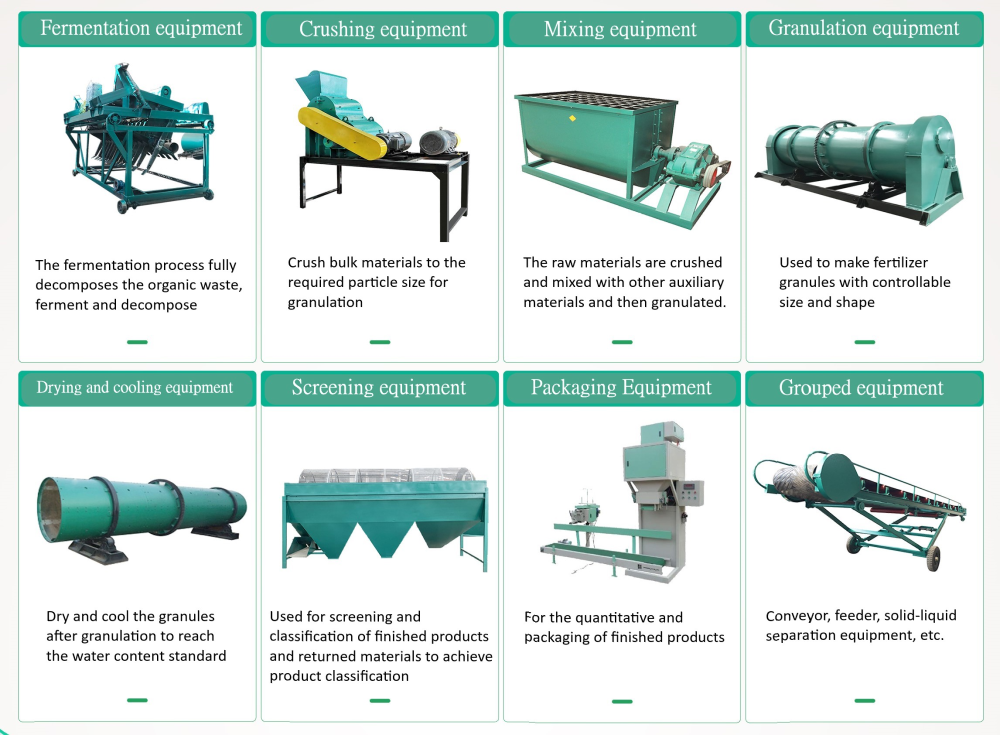
Organic fertilizer processing equipment is not simply an assembly of individual machines. It is an integrated heavy-duty industrial production system encompassing material conveying, biochemical aerobic fermentation, mechanical crushing and shearing, dynamic proportional mixing, granulation, thermal evaporation and drying, and precision mechanical screening.
Drawing on its comprehensive range of CNC machining equipment and stringent quality inspection standards, Zhengzhou Yizheng Heavy Machinery Equipment Co., Ltd. has established a complete product portfolio, ranging from individual core machines to fully automated plant-wide central control systems.
From the initial engineering design stage, the production line is developed with careful consideration of the fluid dynamic and thermodynamic characteristics of organic materials throughout the processing stages.
A complete organic fertilizer production plant generally consists of several major equipment modules:
- Front-End Fermentation and Compost Turning Equipment: Including heavy-duty groove-type compost turners, hydraulic lifting crawler-type compost turners, and other fermentation equipment.
- Intermediate Crushing and Homogeneous Mixing Units: Including semi-wet material crushers, heavy-duty twin-shaft mixers, and associated material handling equipment.
- Core Granulation and Forming Units: Including disc granulators, new-type compound fertilizer stirring-tooth granulators, flat-die extrusion granulators, and other granulation machinery.
- Downstream Processing Equipment: Including large rotary dryers, air cooling systems, screening machines, and automatic quantitative packaging lines.
To accommodate complex industrial dust environments and heavy continuous operating loads, Yizheng Heavy Machinery adopts a modular engineering design philosophy.
This approach allows fertilizer plants to install standardized equipment configurations that match their current production requirements while facilitating smooth integration of additional modules when future capacity expansion becomes necessary.
The main equipment frames are extensively constructed from high-strength carbon structural steel conforming to Chinese national standards and selected grades of corrosion-resistant alloys.
Critical load-bearing bearing housings and transmission gears undergo specialized heat treatment and ultrasonic flaw detection to help maintain reliable and continuous operation under demanding industrial conditions.
II. Working Principle
The industrial-scale production of standardized organic fertilizer is a complex process that integrates mechanical operations with biochemical reactions.
Zhengzhou Yizheng Heavy Machinery’s organic fertilizer processing systems are designed around coordinated physical and biological processing principles.
The production process begins with aerobic fermentation.
Untreated, high-moisture organic solid waste is distributed into fermentation trenches using loaders or belt conveyors.
During this stage, heavy-duty compost turning machines travel along rails or crawler tracks, periodically turning, lifting, dropping, and redistributing the material.
The specially designed teeth on the turning rotors not only break up agglomerated material but also introduce fresh air into the compost pile during the turning process.
This mechanical action accelerates moisture evaporation and disperses heat and carbon dioxide generated by aerobic microbial activity.
By maintaining suitable fermentation conditions, the system promotes biological decomposition, maturation, and the harmless treatment of organic waste.
After fermentation and maturation, the material is conveyed to the crushing and mixing section.
To accommodate the high moisture content and viscosity characteristic of organic materials, Yizheng Heavy Machinery’s specially designed crushing rotors use high-speed rotating forged alloy hammers to apply repeated shearing and impact forces.
These forces break down the material into relatively uniform fine particles.
The crushed material then enters the U-shaped mixing chamber of a twin-shaft mixer.
Two counter-rotating shafts equipped with intermeshing paddles continuously lift, tumble, and mix the material.
This intensive mixing action promotes the uniform distribution of the organic base material, selected microbial agents, and auxiliary ingredients, establishing a homogeneous material foundation for subsequent granulation.
3. Granulation and Particle Formation
At the central granulation stage, the production system selects an appropriate forming mechanism according to the plasticity and processing characteristics of the material.
Taking agglomeration granulation as an example, the homogeneous powder is continuously fed into an inclined disc granulator or rotary drum granulator.
Under the combined effects of centrifugal force, gravity, and friction between particles, the material rolls along controlled trajectories.
Meanwhile, an automated hydraulic atomization system evenly sprays water or a suitable binder onto the moving material bed.
Through continuous rolling, collision, and agglomeration, the powder particles gradually become denser and form spherical granules with the required mechanical strength.
Because freshly formed fertilizer granules contain relatively high levels of free moisture, they are conveyed into a rotary dryer for thermal dehydration.
The dryer drum rotates slowly, supported by heavy-duty riding rollers and driven by a gear transmission system.
Specially designed internal lifting flights continuously lift and disperse the material, forming a uniform curtain of particles.
Hot air generated by the supporting hot-air furnace passes through the material curtain in either a co-current or counter-current arrangement, allowing effective heat and mass transfer.
As a result, a substantial portion of the moisture evaporates from the fertilizer granules.
5. Cooling
After drying, the granules enter a cooling machine.
Ambient-temperature airflow removes residual heat from the particles, reducing their temperature and further improving their surface hardness and physical stability.
6. Screening and Material Recycling
The cooled granules pass through a rotary screening machine, which separates qualified particles from oversized material and fines.
Nonconforming material is returned to the appropriate upstream processing stages for reprocessing.
This recycling arrangement helps maintain consistent product specifications and improves raw material utilization.
Qualified finished granules are conveyed into an automatic quantitative packaging system.
The equipment performs accurate weighing, filling, and packaging, preparing the finished organic fertilizer for commercial distribution.
III. Product Applications
With strong mechanical adaptability and flexible process configurations, this series of organic fertilizer processing equipment serves a wide range of applications across modern agricultural production and municipal solid waste resource recovery.
1. Large-Scale Livestock and Poultry Farming
The equipment is widely used to process chicken manure, cattle manure, pig manure, and sheep manure generated by large-scale livestock and poultry farms.
These materials often have high moisture content, complex fibrous structures, and substantial amounts of sticky impurities.
Through reinforced anti-blockage mechanisms and corrosion-resistant equipment designs, Yizheng Heavy Machinery’s production lines can continuously process these materials and convert them into commercial organic fertilizers containing nitrogen, phosphorus, potassium, organic matter, and various secondary and trace elements.
2. Agricultural Waste Recycling
For agricultural residues such as crop straw, rice husks, mushroom cultivation residues, and sawdust, which often contain relatively high levels of lignin, the production line can be equipped with pretreatment modules featuring powerful shearing and tearing capabilities.
These modules break down plant fiber structures, helping accelerate subsequent aerobic fermentation and potentially shorten the overall fermentation cycle.
3. Municipal Sludge and Food Waste Treatment
The equipment can also be deployed in municipal sludge treatment and large-scale food waste resource recovery projects.
Municipal organic waste may have complex compositions and potential biological hazards.
Enclosed biochemical fermentation and thermal drying systems can support pathogen inactivation and material stabilization under appropriately controlled processing conditions.
Following suitable treatment, testing, and compliance with applicable regulations, processed materials may be used in applications such as landscaping, saline-alkaline soil rehabilitation, and ecological restoration of degraded mining areas.
4. Organic-Inorganic Compound Fertilizer and Specialty Fertilizer Production
With an automatic batching and metering system, fertilizer plants can adjust raw material proportions according to different formulations.
This enables flexible production of organic-inorganic compound fertilizers and specialty formulated fertilizers using suitable process configurations.
IV. Product Features
Zhengzhou Yizheng Heavy Machinery follows rigorous heavy-industrial manufacturing standards in the design and production of equipment components, providing its organic fertilizer processing lines with several important engineering advantages.
1. Rigid and Robust Mechanical Structure
The fundamental requirement of an industrial production line is its ability to operate continuously under load over extended periods.
The main frames of this equipment series are constructed extensively from thickened channel steel and I-beams conforming to Chinese national standards.
Critical load-bearing joints are reinforced through multilayer welding processes.
Key components that come into direct contact with corrosive materials, including internal liners, mixing shafts, and granulation transmission components, are manufactured using selected stainless steel grades or wear-resistant alloys subjected to high-frequency quenching.
This heavy-duty corrosion- and wear-resistant design helps reduce damage caused by acidic or alkaline environments and high-friction material handling, extending the overall service life of the equipment.
2. Continuous and Efficient Material Flow
The integrated production line is engineered to eliminate capacity mismatches between individual machines.
The throughput of each processing stage is coordinated through engineering calculations and material flow analysis.
From variable-frequency adjustment of upstream feeding rates to controlled discharge of finished products, material movement is designed to remain smooth throughout the production line.
This coordinated arrangement helps reduce shutdowns caused by material accumulation or mismatched processing capacities, supporting continuous industrial-scale production.
3. Comprehensive Environmental Protection Design
As industrial environmental standards become increasingly stringent, Yizheng Heavy Machinery incorporates dust and emission control equipment into its fertilizer processing systems.
In sections where dust is generated, particularly thermal drying and mechanical crushing, the production line can be equipped with:
- Multistage dust settling chambers
- High-capacity cyclone dust collectors
- Water-scrubbing dust removal and desulfurization systems
- Enclosed negative-pressure dust extraction networks
For odors such as ammonia generated in fermentation workshops, the system can also be integrated with biological deodorization towers and other downstream gas treatment equipment.
These configurations help fertilizer plants control emissions and meet applicable environmental protection requirements.
4. Integrated Industrial Automation Control
The central control system of the production plant uses industrial programmable logic controllers (PLCs), supported by dust-resistant and explosion-protected touchscreen terminals where required.
From an independent central control room, operators can monitor operating parameters across numerous production line points, including:
- Motor current loads
- Operating voltages
- Bearing temperatures
- Motor rotational speeds
- Equipment operating conditions
Sensors installed on critical machines detect abnormal operating conditions, such as localized overloads or excessive temperature increases.
When a fault is detected, the control system can activate audible and visual alarms and safely disconnect affected power circuits according to the configured protection logic.
These functions help improve operational reliability and personnel safety.
V. Product Specifications
To assist project engineers and procurement teams in conducting technical evaluations, the following are representative engineering parameters for Zhengzhou Yizheng Heavy Machinery’s standard complete organic fertilizer production lines.
Actual specifications may vary depending on the customer’s required plant capacity, selected production process, and raw material characteristics.
1. Production Capacity
The equipment portfolio supports production lines ranging from small pilot-scale systems with processing capacities of approximately 1 ton per hour to large continuous industrial production lines with capacities of 20 tons per hour or more.
2. Recommended Material Moisture Content
Before fermentation, the recommended moisture content of the mixed raw materials and auxiliary ingredients is generally maintained within the range of 55%–65%.
For homogeneous powder entering the granulation equipment, the moisture content is preferably controlled at approximately 30%, depending on the selected granulation method and material characteristics.
3. Finished Granule Size
By adjusting granulator rotational speed, inclination angle, and screening aperture size, the finished fertilizer granules can be produced within a standard particle size range of approximately 2–4 mm.
4. Installed Power and Energy Consumption
Depending on production capacity, the total installed power of the complete production line may range from several tens of kilowatts to several hundred kilowatts.
The power transmission systems generally use high-torque industrial gear reducers combined with energy-efficient motors conforming to applicable national standards.
This configuration supports stable power transmission and appropriate torque distribution.
5. Operating Temperature Control
The hot-air inlet temperature of the rotary dryer is generally set within the range of 200°C–300°C.
Temperature sensors and control components dynamically regulate the airflow temperature to support efficient evaporation of free moisture while taking into account the temperature sensitivity of beneficial microorganisms in the fertilizer.
6. Plant Space Requirements and Equipment Layout
The required plant area depends significantly on the selected fermentation method and overall process configuration.
Yizheng Heavy Machinery’s structural engineers can develop three-dimensional equipment layout drawings according to the actual dimensions and geometry of the customer’s site, helping improve overall space utilization.
In the extensive market for agricultural waste treatment and fertilizer engineering equipment, the selection of complete production systems directly affects the operational stability and return on investment of a newly established fertilizer plant over its long service life.
The preceding analysis of equipment structures, processing principles, and engineering applications demonstrates that the organic fertilizer processing equipment developed and manufactured by Zhengzhou Yizheng Heavy Machinery Equipment Co., Ltd. is built upon substantial heavy-machinery manufacturing expertise and rigorous industrial engineering principles.
The company consistently focuses on the scientific treatment of metal materials, dynamic optimization of transmission structures, and comprehensive integration of automated production control systems, providing fertilizer manufacturers in domestic and international markets with a reliable equipment foundation.
In today’s fertilizer equipment manufacturing market, Yizheng Heavy Machinery serves not only as a manufacturing base for high-standard industrial machinery but also as an integrated engineering service provider offering complete process layout design, equipment installation and commissioning, and ongoing maintenance support.
For investors currently undertaking project preparation and technical feasibility evaluations, a thorough assessment of equipment materials, manufacturing processes, operational continuity, and the manufacturer’s heavy-equipment delivery capabilities is essential to ensuring successful project implementation.
Choosing Zhengzhou Yizheng Heavy Machinery means choosing an industrial development approach focused on robust manufacturing, reliable equipment performance, and long-term operational stability.
Add a buyer-focused selection checklistClarify which process routes are optional
For more inquiries or more information, please contact:
Sales Department / Tina Tian
+86 – 15538237222
Zhengzhou Yizheng Heavy Machinery Equipment Co., Ltd
Email: tianyaqiong@yz-mac.cn
Website: www.yz-mac.com
Post time: Oct-19-2026