

I. Product Overview:
As the agricultural sector pivots toward sustainable development, reducing chemical fertilizer use and focusing on soil restoration have become industry imperatives. Organic fertilizer processing equipment serves as the primary technical vehicle for converting agricultural waste into valuable resources. The quality and commercial viability of organic fertilizer depend directly on the sophistication of this technology.
A modern organic fertilizer production line is an integrated system combining biological fermentation, mechanical processing, and automated control. It is designed to transform biomass—such as livestock manure, crop straw, municipal waste, distillers’ grains, and sugar refinery sludge—into high-quality fertilizer characterized by balanced nutrients, stable properties, and ease of application.
Leveraging years of expertise in fertilizer machinery, Zhengzhou Yizheng Heavy Machinery Equipment Co., Ltd. has developed complete sets of processing equipment that achieve full automation, from raw material intake to finished product packaging. Our production lines resolve the environmental challenges of waste accumulation while utilizing scientific “harmlessness, reduction, and resource recovery” protocols. The resulting granular fertilizer is rich in organic matter, humic acid, and beneficial microbial flora. Built with industrial-grade heavy configurations, the equipment is specifically engineered to handle the high humidity, corrosivity, and stickiness typical of organic fertilizer production, ensuring stable performance under intensive operational conditions.
II. Working Principle:
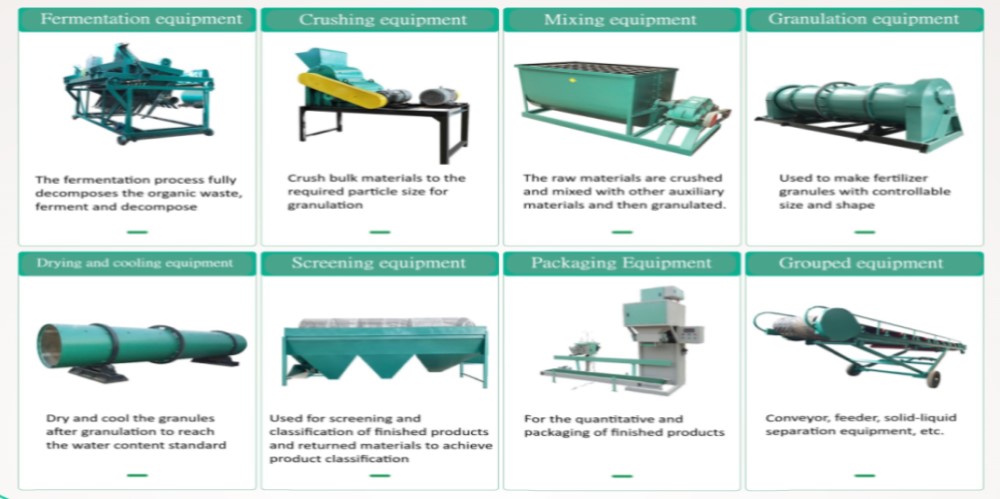
The system operates on a dual logic of “biological conversion supported by mechanical processing.” The production line is organized into interconnected stages: fermentation, pre-treatment, granulation, and post-treatment.
(1). Biological Fermentation and Deodorization
This critical first stage involves mixing raw materials (e.g., manure) with auxiliary materials (e.g., straw powder). Trough-type or mobile compost turners utilize high-speed rotating drums to flip and agitate the material. This mechanical action breaks up compaction, increases oxygen exposure, and stimulates the rapid growth of aerobic microorganisms. The resulting high temperatures (reaching 60–75°C) eliminate parasites and pathogens while promoting moisture evaporation, reducing water content to approximately 35% and stabilizing the compost.
(2). Precision Crushing and Mixing
Fermented materials often contain clumps and uneven nutrient distribution. A semi-wet material crusher uses high-speed vertical blades to shear the material into fine powder (under 3mm). Subsequently, the material enters a horizontal mixer where functional microbial strains or NPK elements can be added. Dual or single-shaft screw blades create radial, circular, and axial flow patterns, ensuring microscopic uniformity within the mixture.
(3). Particle Formation (Core Granulation)
Our production lines utilize a “new type” organic fertilizer granulator. The process leverages friction, centrifugal force, and extrusion generated between high-speed rotating stirring teeth and the drum wall. Under specific humidity conditions, powdered material begins to layer and grow around fine fibers or powder cores. The material then moves into the rotary drum section where surface tension and mechanical polishing refine the granules into a dense, rounded form. This hybrid “stirring tooth + rotary drum” method successfully addresses the challenges of processing low-density, high-fiber organic materials.
(4). Drying, Cooling, and Screening
Freshly formed granules are high in moisture and low in hardness. A rotary dryer utilizes heat exchange with hot air to remove internal moisture. This is followed by a rotary cooler, which introduces ambient air to rapidly lower temperatures. This process increases particle strength through thermal contraction and prevents condensation after packaging. Finally, a trommel screen grades the product; qualified granules proceed to packaging, while oversized chunks are crushed and fines are re-fed into the granulator, ensuring zero-waste operation.
III. Strategic Applications:
The equipment offers broad material compatibility across several sectors:
- Livestock Waste Recovery: Manure management for large-scale poultry, pig, and cattle farms, turning environmental liabilities into economic assets.
- Agricultural Residue Processing: Converting corn straw, wheat husks, and peanut vines into compost to maintain soil fertility.
- Industrial Organic By-products: Processing distillers’ grains, vinegar residue, soy sauce dregs, and sugar mill filter mud.
- Municipal Environmental Projects: Treating municipal sludge, garden waste, and food scraps for use in urban landscaping and nurseries.
- Specialty Fertilizer Production: Manufacturing bio-organic fertilizers, soil conditioners, and carbon-based fertilizers tailored for precision agriculture.
IIV. Technical Features:
Our equipment is engineered for the rigors of organic fertilizer production:
- Superior Corrosion Resistance: Given the high humidity and presence of ammonia or hydrogen sulfide, critical components—such as fermentation blades, granulator linings, and dryer plates—are constructed from 304# stainless steel or specialized anti-corrosive alloys.
- High-Efficiency Granulation: Our composite technology achieves a balling rate exceeding 95%. The granules are uniform, aesthetically pleasing, and possess high compressive strength (≥15N), making them ideal for mechanized sowing.
- Automated Intelligence: The entire line can be integrated with a PLC control system for real-time monitoring of fermentation temperatures, drying heat, drum speeds, and material flow. This minimizes labor dependency while ensuring batch consistency.
- Environmental Compliance: A fully enclosed design prevents dust and odor leakage. Systems can be equipped with pulse-type bag dust collectors and bio-filtration towers to meet strict environmental emission standards.
- Modular Flexibility: We offer modular configurations that allow clients to start with powder production and upgrade to granulation lines later. Functional modules like dewatering or secondary drying can be added based on raw material characteristics to maximize ROI.
Zhengzhou Yizheng Heavy Machinery Equipment Co., Ltd. provides more than just machinery; we offer a mature solution for waste management and resource development. Our systems address the industry’s core pain points—slow granulation, equipment corrosion, and fermentation challenges—providing the hardware foundation for modern, green fertilizer production.
For more inquiries or more information, please contact:
Sales Department / Tina Tian
+86 – 15538237222
Zhengzhou Yizheng Heavy Machinery Equipment Co., Ltd
Email: tianyaqiong@yz-mac.cn
Website: www.yz-mac.com
Post time: Apr-27-2026