

Combining hot-air convective heat transfer with complete-plant process integration to help fertilizer enterprises worldwide maintain stable control over granule moisture content.
During the production of organic fertilizers, a drying process is often required to remove excessive moisture, improve fertilizer quality, and enhance storage stability. Hot-air drying equipment is a common type of organic fertilizer drying equipment. Its working principle involves using flowing hot air to dry high-moisture organic fertilizer inside a drying chamber. Under the action of high-temperature hot air, moisture evaporates, thereby achieving the purpose of drying.
The main components of organic fertilizer hot-air drying equipment include a feeding device, hot-air generation device, drying device, and discharging device. It features simple operation, high production efficiency, and good drying performance, meeting the organic fertilizer drying requirements of different production scales and specifications.
In modern industrial-scale organic fertilizer production, transforming high-moisture materials that have undergone aerobic fermentation and physical granulation into commercial granular products that meet market distribution and long-term storage requirements depends on a stable and controllable thermal dehydration process. Newly formed wet organic fertilizer granules typically contain relatively high proportions of free moisture and capillary water. Without systematic thermal drying treatment, the granules not only exhibit low physical compressive strength and are highly susceptible to crushing under pressure during bagged stacking, but may also undergo secondary fermentation, moisture reabsorption, caking, and nutrient loss during storage. Organic fertilizer hot-air drying equipment is the core thermal processing equipment used to overcome this process bottleneck. Zhengzhou Yizheng Heavy Machinery Equipment Co., Ltd. has long focused on the research, development, and heavy-duty manufacturing of complete fertilizer machinery systems, deeply integrating industrial thermodynamics, fluid dynamics, and heavy machinery manufacturing processes to develop rotary hot-air drying systems designed for continuous factory operation. The equipment design avoids lightweight, non-standard assembled structures and strictly follows the rigid load-bearing standards and thermal control principles of heavy industrial equipment. Through precise verification of the hot-air flow field, material lifting and scattering trajectories, and sealing and corrosion-resistant structures, the company provides domestic and international organic fertilizer processing enterprises with continuous, smooth, and reliable material drying engineering support, demonstrating solid machinery and equipment manufacturing capabilities.
I. Product Overview
In terms of process characteristics, organic fertilizer hot-air drying equipment is a large-scale rotary drum thermal drying unit with continuous feeding and discharging. In a standard complete organic fertilizer production line layout, the equipment is closely connected between the upstream granulation section (such as a disc granulator, stirring-tooth granulator, or double-roller extrusion granulator) and the downstream cooling and screening section, undertaking the important task of transforming wet semi-finished products into dry, formed granules. Wet organic fertilizer granules freshly discharged from the granulation chamber generally have a moisture content ranging from 25% to 35%. After heat and mass transfer through the hot-air drying system, the moisture content of the finished granules can steadily decrease to the commercially safe storage standard range of 10% to 15%.
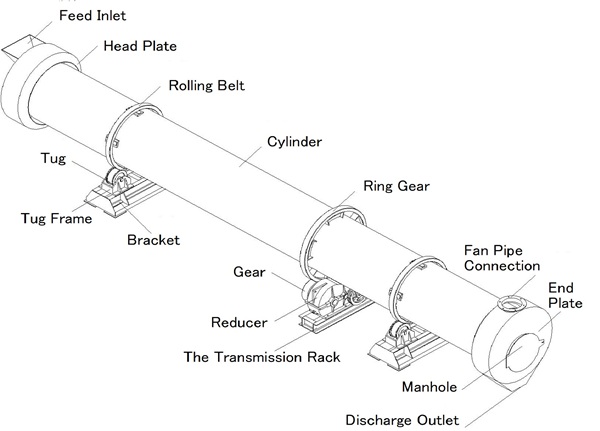
From the perspective of the complete mechanical structure, the organic fertilizer hot-air drying equipment manufactured by Zhengzhou Yizheng Heavy Machinery Equipment Co., Ltd. mainly consists of five major units: the hot-air generation system, rotary drying main unit, support and transmission assembly, sealed feeding and discharging devices, and exhaust gas dust collection and purification network. The core of the main unit is a large-diameter cylindrical rotary drum with a length-to-diameter ratio determined through thermal engineering calculations. The drum body is fabricated by rolling and welding thickened carbon structural steel plates that comply with national industrial standards. Heavy-duty steel riding rings (tyres), which undergo integral forging and quenching and tempering heat treatment, are scientifically installed around the exterior of the drum. These riding rings rest smoothly between the heavy-duty cast steel support roller assemblies and thrust roller mechanisms on the base, forming a stable dynamic load-bearing system.
The drive unit consists of a high-power industrial motor, a hardened cylindrical gear reducer, a transmission pinion, and a heavy-duty large ring gear fixed at the middle of the drum, ensuring that the drum maintains uniform low-speed rotation even under fully loaded operating conditions. Multiple sets of metal lifting flights with specific inclination angles are arranged in arrays along the circumference and axial direction of the drum’s inner wall. Yizheng Heavy Machinery applies automatic submerged arc welding processes and ultrasonic flaw detection inspections to all longitudinal and circumferential drum welds and riding ring support seat joints, ensuring the structural stability and fatigue resistance of the entire machine under long-term thermal expansion and contraction cycles and continuous heavy-load rotation.
II. Working Principle
The dehydration operation of organic fertilizer hot-air drying equipment is an industrial process involving the coordinated action of forced convective heat transfer, thermal conduction, and mechanical movement under gravity. The material flow and hot-air flow throughout the system operate strictly according to predetermined fluid dynamics trajectories.
The drying process begins with continuous quantitative feeding. Wet organic fertilizer granules formed by the upstream granulator are transported by a belt conveyor into a feed chute equipped with a mechanical labyrinth seal and an air-lock valve, then smoothly slide into the higher end of the rotary drum, which is installed at an axial inclination of 2% to 5%. Under the combined action of the drum’s circumferential rotation and the axial component of gravity, the wet granules slowly advance along a spiral trajectory from the feed end toward the discharge box at the lower end.
While the granules move axially, the combined lifting flights welded to the inner wall of the drum continuously perform mechanical work. As the drum rotates at a uniform speed, the lifting flights repeatedly scoop up wet granules accumulated at the bottom of the drum, raise them to the upper region of the drum’s cross-section, and then allow them to fall uniformly in a cascading pattern under gravity. This continuous cycle of “scooping—lifting—scattering” creates dense, evenly distributed dynamic material curtains inside the drum, multiplying the contact area between the granules and hot air.
Meanwhile, clean hot air generated by the supporting hot-air furnace (which can accommodate heat sources such as biomass fuel, natural gas, diesel, or clean coal) continuously enters the drum under the slight negative pressure created by a high-power induced-draft fan at the end of the system. The hot airflow passes through the dynamic material curtains in either a co-current configuration (hot air and material flowing in the same direction) or a counter-current configuration, allowing direct and sufficient heat and mass transfer between the gas and solid phases. The sensible heat carried by the hot air is rapidly transferred to the wet granules, causing free moisture on the granule surfaces to absorb heat and vaporize quickly. As surface moisture evaporates and creates a humidity gradient, capillary-bound water inside the granules gradually migrates toward the surface and continues to evaporate.
Considering that organic fertilizers often contain humic acid and beneficial microbial communities, the equipment strictly controls the temperature range of the hot air entering the drum to accelerate moisture evaporation while preventing high temperatures from causing organic matter carbonization or the inactivation of beneficial microorganisms. The water vapor generated by evaporation joins the airflow to form high-humidity exhaust gas, which is extracted by the induced-draft fan and sent to the dust collection and purification system. Meanwhile, the dried and formed granules reach the lower end of the drum, are discharged through the discharge box, and enter the subsequent cooler for temperature reduction and final stabilization.
III. Product Applications
With its good adaptability to high-moisture, slightly sticky materials and heavy-industrial-grade structural load-bearing capacity, the organic fertilizer hot-air drying equipment manufactured by Zhengzhou Yizheng Heavy Machinery Equipment Co., Ltd. has been widely applied in various industrial scenarios involving ecological agricultural fertilizer processing and organic solid waste resource recovery.
In large-scale livestock and poultry manure resource recovery projects, this equipment is a standard core component for processing fermented and matured materials such as chicken manure, cattle manure, pig manure, sheep manure, and duck manure. Even after preliminary aerobic composting and granulation, livestock and poultry manure granules still contain considerable colloidal moisture internally and are prone to softening when exposed to moisture. Through gentle dehydration by the hot-air drying system, soft wet granules can be solidified into commercial organic fertilizers with good roundness, high compressive strength, and suitability for bagged storage and mechanized spreading.
In the conversion of agricultural planting by-products and industrial organic residues, this equipment is widely used in production projects involving fermented crop straw fertilizer, mushroom residue organic fertilizer, sugar mill filter mud organic fertilizer, bio-organic fertilizer made from distillers’ grains and medicinal residues, and digestate drying in large-scale biogas projects. To accommodate differences in bulk density, adhesiveness, and initial moisture content among various raw materials, the equipment can steadily complete continuous dehydration operations by adjusting the hot-air temperature, drum rotational speed, and airflow ratio.
In addition, this hot-air drying equipment demonstrates outstanding process compatibility in municipal sludge sanitization, drying, and fertilizer production, as well as integrated organic-inorganic compound fertilizer production lines. Whether for small and medium-sized regional fertilizer processing plants with annual production capacities of approximately 10,000 tons or large continuous industrial production facilities processing hundreds of tons per day, Yizheng Heavy Machinery can configure matching drum specifications and auxiliary thermal systems according to the actual raw material characteristics and production capacity plans of the plant.
IV. Product Features
When designing and manufacturing organic fertilizer hot-air drying equipment, Zhengzhou Yizheng Heavy Machinery Equipment Co., Ltd. consistently adheres to the engineering standards of heavy machinery and the principle of long-term operating economy, giving the equipment the following significant technical features:
1. Heavy-Duty Rigid Main Structure and Wear-Resistant, Corrosion-Resistant Processes: Considering that organic fertilizer materials are generally mildly acidic, have high moisture content, and continuously rub against the drum wall, the dryer drum is manufactured from thickened, high-quality carbon steel plates conforming to national standards. Corrosion-resistant stainless steel lining plates can be optionally installed in the high-moisture, high-temperature section at the feed end. The heavy-duty forged steel riding rings and cast steel support rollers undergo rigorous turning and surface quenching treatments, ensuring a high degree of contact surface conformity. This significantly reduces radial runout and mechanical wear during long-term continuous drum operation and extends the service life of core components.
2. Three-Dimensionally Staggered Lifting-Flight Arrays and Thermal Utilization Optimization: Based on the fluid dynamics parameters of drums with different diameters, Yizheng Heavy Machinery arranges lifting-type, spiral-advancing, and combined lifting flights in different sections inside the drum. The feeding section uses large-pitch spiral blades to quickly move newly introduced high-moisture granules away from the feed inlet, preventing localized adhesion to the drum wall and material blockage. The middle drying section uses staggered curved lifting flights to form uniform material curtains without dead zones, effectively eliminating the “wind tunnel short-circuit” phenomenon in which hot air passes directly through without sufficient contact with the material, allowing thermal energy to be fully utilized for moisture evaporation.
3. Tight End-Face Sealing and Slight Negative-Pressure Environmental Dust Control: Both the feeding and discharging ends of the drum are equipped with high-temperature-resistant flexible graphite and labyrinth-type composite sealing devices, effectively preventing heat loss caused by cold air leaking into the drum while also preventing hot gas and dust from escaping. The entire system maintains slight negative-pressure operation under the action of the induced-draft fan. The discharged high-humidity, dust-laden exhaust gas sequentially enters a large-diameter cyclone dust collector and a water-bath (or spray) dust collection and settling chamber, where particulate matter is effectively captured and recovered, ensuring that the plant’s working environment and exhaust emission indicators comply with industrial environmental protection regulations.
4. Smooth and Reliable Heavy-Duty Gear Transmission System: The power transmission system uses an industrial-grade hardened gear reducer combined with a high-strength alloy steel pinion and a split-type large ring gear, providing high gear meshing precision and sufficient torque-bearing capacity. Even when short-term fluctuations occur in the thickness of the material layer inside the drum, the drum maintains smooth operation, with low transmission noise and convenient routine lubrication and maintenance.
5. Flexible and Adjustable Automated Process Control: The equipment’s electrical control system integrates temperature sensor monitoring and variable-frequency speed control modules. Operators can monitor the hot-air furnace outlet temperature, dryer inlet air temperature, and exhaust gas temperature in real time through the control cabinet panel. According to changes in seasonal air humidity or the initial moisture content of materials, they can adjust the drum rotational speed and the induced-draft fan damper opening through variable-frequency drives, achieving precise control over drying intensity.
V. Product Specifications
To facilitate preliminary process planning and equipment selection by engineering technicians, project investors, and procurement departments, the following are the conventional technical parameters of typical organic fertilizer hot-air drying equipment manufactured by Zhengzhou Yizheng Heavy Machinery Equipment Co., Ltd. (Actual engineering configurations will be calculated according to the customer’s raw material characteristics, heat source type, and workshop layout):
1. Single-Machine Processing Capacity: Covers a wide range and can meet the production capacity requirements of organic fertilizer production lines of different scales, from 1.0 ton per hour to 20.0 tons per hour or more.
2. Rotary Drum Specifications: The conventional series of effective internal drum diameters ranges from Φ1.0 meter to Φ3.0 meters, while the total drum length ranges from 10.0 meters to 30.0 meters according to the required thermal residence time of the material.
3. Drum Installation Inclination: The factory-designed installation slope ranges from 2.0% to 5.0%, utilizing the gravitational component to achieve smooth material movement toward the discharge end.
4. Drum Operating Speed: The conventional operating speed ranges from 3.0 to 8.0 revolutions per minute, with an optional variable-frequency speed control device for stepless adjustment.
5. Hot-Air Inlet Temperature: Considering the heat sensitivity of organic fertilizers and the process requirements for protecting beneficial microbial communities, the hot-air inlet temperature is usually controlled within the range of 200°C to 300°C.
6. Material Moisture Removal Specifications: The applicable initial moisture content range of incoming wet granules is 25% to 35%. After hot-air drying, the moisture content of the discharged finished product is consistently controlled between 10% and 15%.
7. Main Unit Drive Power: Depending on the drum dimensions and the total weight of fully loaded materials, the main drive motor power ranges from 11.0 kW to 110.0 kW (excluding the power of the hot-air furnace blower and exhaust gas induced-draft fan).
8. Compatible Heat Source Types: Supports various thermal configurations, including biomass pellet burners, natural gas burners, oil-fired hot-air furnaces, and clean coal-fired hot-air furnaces.
|
Model |
The diameter (mm) |
The length (mm) |
External dimension after installation (mm) |
Speed (r/min) |
Motor type |
Power (kw) |
|
YZHG-0880 |
800 |
8000 |
9000×1700×2400 |
6 |
Y132S-4 |
5.5 |
|
YZHG-10100 |
1000 |
10000 |
11000×1600×2700 |
5 |
Y132M-4 |
7.5 |
|
YZHG-12120 |
1200 |
12000 |
13000×2900×3000 |
4.5 |
Y132M-4 |
7.5 |
|
YZHG-15150 |
1500 |
15000 |
16500×3400×3500 |
4.5 |
Y160L-4 |
15 |
|
YZHG-18180 |
1800 |
18000 |
19600×3300×4000 |
4.5 |
Y225M-6 |
30 |
|
YZHG-20200 |
2000 |
20000 |
21600×3650×4400 |
4.3 |
Y250M-6 |
37 |
|
YZHG-22220 |
2200 |
22000 |
23800×3800×4800 |
4 |
Y250M-6 |
37 |
|
YZHG-24240 |
2400 |
24000 |
26000×4000×5200 |
4 |
Y280S-6 |
45 |
Within the complete process chain of modern organic fertilizer production, organic fertilizer hot-air drying equipment is not only the core thermal processing unit for solidifying the physical form of materials but also a critical stage determining the mechanical strength of finished granules, long-term storage stability, and commercial product quality. Scientifically and steadily removing excess moisture from inside the granules can effectively prevent fertilizer breakage and caking during packaging, transportation, and mechanized field application, creating a solid foundation for the product competitiveness of fertilizer manufacturers. Zhengzhou Yizheng Heavy Machinery Equipment Co., Ltd. builds upon the engineering foundations of heavy machinery manufacturing, integrating rigorous structural design, solid metal processing techniques, and systematic thermal fluid control. The company is committed to providing domestic and international customers with complete organic fertilizer hot-air drying equipment featuring stable operation, convenient maintenance, and environmental compliance. For fertilizer enterprises planning to establish new factories or upgrade existing production lines, selecting drying equipment with high process compatibility and a robust, reliable mechanical structure is a solid foundation for ensuring long-term continuous and stable production throughout the entire production line, controlling overall operating costs, and consistently producing standardized, high-quality organic fertilizers.
For more inquiries or more information, please contact:
Sales Department / Tina Tian
+86 – 15538237222
Zhengzhou Yizheng Heavy Machinery Equipment Co., Ltd
Email: tianyaqiong@yz-mac.cn
Website: www.yz-mac.com
Post time: Nov-20-2026