

I. Product Overview:
In the organic fertilizer production process, finished product grading and the handling of off-spec material are critical steps that determine the final marketability of the product. The Organic Fertilizer Screening and Re-feed System is a closed-loop operational framework specifically engineered for large-scale production lines. Rather than being a standalone screening tool, this system integrates conveying, grading, crushing, and automated re-feeding functions. It is designed to solve the common issue of inconsistent yields caused by varying particle sizes and moisture fluctuations after granulation.
As regulatory standards for bio-organic fertilizer quality tighten, the market now demands higher uniformity and sphericity in granules. Through a precise process layout, this system subjects dried and cooled materials to multi-stage screening. High-quality granules proceed directly to packaging, while oversized chunks and fine powders are accurately diverted back to the granulation or grinding stages for reprocessing. By enabling a zero-waste production cycle, this system serves as a core equipment suite for modern organic fertilizer plants looking to boost capacity and optimize costs.
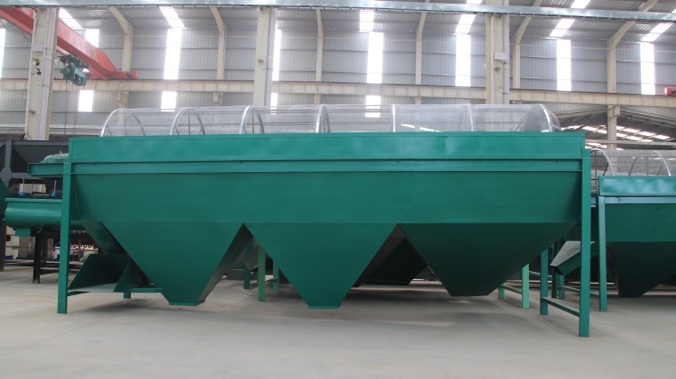
II. Working Principle:
The system operates on a logic of “graded disposal and closed-loop cycling,” divided into the following stages:
- Multi-Stage Screening: Dried and cooled organic fertilizer granules are fed into the main screening unit (typically a high-capacity rotary drum screen or multi-deck vibrating screen) via belt conveyor. Inside the unit, materials are separated by physical size into three categories:
-Finished Product: Granules (typically 2.0mm–4.5mm) exit through the qualification port.
-Oversized Material: Chunks exceeding the upper limit are directed to the end of the top screen deck.
-Fines/Powder: Material smaller than the lower limit passes through the bottom mesh into a collection hopper.
- Re-feed Processing: The oversized materials are discharged into an integrated chain crusher or cage crusher, which grinds them down to below the qualified diameter. This reground material is then combined with the fines collected from the bottom screen on a re-feed conveyor.
- Secondary Granulation Cycle: The re-feed system utilizes an elevator or inclined belt to return these powdered materials to the front end of the granulator. In the granulation process, this recycled material acts as a “mother liquor” or seed. When mixed with new fermented base material, it not only improves the balling rate but also uses its lower moisture content to balance the humidity of the fresh material, further stabilizing the production parameters.
III. Product Applications:
The screening and re-feed system is an essential link in the deep processing of various organic fertilizers:
- Livestock Manure Lines: For chicken, pig, or cattle manure with high fiber content, the system effectively removes incompletely decomposed fibrous clumps to improve product purity.
-Bio-Organic & Compound Microbial Fertilizers: During the granulation process after inoculant addition, the system ensures precise size control, which aids in uniform microbial distribution and subsequent coating treatments.
-Municipal Sludge & Waste Compost: Used to filter out residual trace impurities, ensuring the finished fertilizer does not clog nozzles or seeders during mechanized farming applications.
-Compatibility with Disc & Rotary Drum Granulation: Regardless of the granulation method, this system integrates seamlessly to automatically regulate material balance and prevent production fluctuations caused by manual re-feeding.
IV. Product Features:
Designed for the specific characteristics of organic materials and harsh production environments, the system features four key technical advantages:
1.Intelligent Automation: The system features an interlocking design where re-feed speeds can be synchronized with the granulator’s intake. This automated path reduces labor costs and dust generation associated with manual transport.
2.Anti-Clogging Technology: Organic fertilizers often contain oils and moisture that can easily blind screens. This system is equipped with forced cleaning mechanisms (such as heavy-duty beaters or high-strength nylon brushes) to ensure the mesh remains clear, maintaining high efficiency even with humid materials.
3.Reinforced Corrosion Resistance: Organic fertilizer plants are high-humidity environments prone to ammonia and nitrogen corrosion. All critical contact parts and conveyor frames undergo deep anti-corrosion treatment; select models utilize 304 stainless steel to resist the acidic and alkaline by-products of fermentation.
4.Environmental & Dust Control: The entire screening and re-feed circuit adopts a fully enclosed structural design with flexible seals at all connection points and dedicated dust extraction ports. This prevents fine particulates from escaping, protecting worker health and meeting strict environmental compliance standards.
For more inquiries or more information, please contact:
Sales Department / Tina Tian
+86 – 15538237222
Zhengzhou Yizheng Heavy Machinery Equipment Co., Ltd
Email: tianyaqiong@yz-mac.cn
Website: www.yz-mac.com
Post time: Feb-23-2026