

I、Product Overview
Under the current global trend of promoting green agricultural transformation and sustainable soil development, the “organic fertilizer production process” has evolved from traditional simple composting into a standardized, large-scale, and industrialized biochemical processing system.
The organic fertilizer production process aims to convert various types of biomass waste—including livestock and poultry manure, crop straw, sugar factory filter mud, distiller’s grains, pharmaceutical residues, and municipal sludge—into high-quality organic fertilizers with stable nutrients, uniform particle size, and a high degree of harmlessness through scientific formulation and mechanized processing.
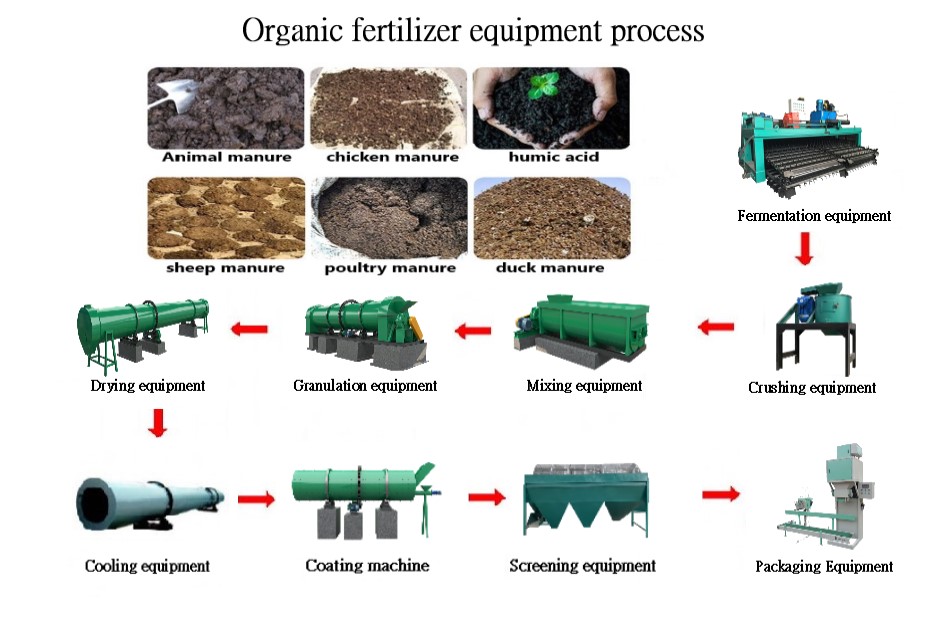
This process is not only a key pathway to solving agricultural non-point source pollution and achieving resource utilization of waste, but also a core method for improving soil quality and enhancing soil microbial ecosystems. Modern production line processes cover material pretreatment, aerobic fermentation, fine crushing, precise batching, efficient granulation, as well as subsequent drying, screening, and automatic packaging.
The organic fertilizer process solutions designed by Zhengzhou Yizheng Heavy Machinery Equipment Co., Ltd. integrate biodegradation technology with mechanical engineering, enabling targeted optimization based on the physical characteristics of different raw materials (such as viscosity, moisture content, and fiber content), ensuring that the final products exhibit excellent commercial value and agronomic performance.
II、Working Principle
The organic fertilizer production process is a complex system driven by microbial metabolism and mechanical forming forces. Its core principles can be divided into two key stages: “biochemical transformation” and “physical mechanical processing.” The detailed process is as follows:
(1) Aerobic Fermentation and Microbial Transformation Principle
This is the starting point of the process. Raw materials enter the fermentation zone and are regularly turned using groove-type or wheel-type compost turners.
- Heat generation and temperature rise:
Under sufficient oxygen, appropriate moisture content (50%–60%), and a balanced carbon-to-nitrogen ratio (C/N), aerobic microorganisms rapidly decompose organic matter. The energy released from microbial respiration raises the pile temperature quickly to 55–70°C.
- Harmless treatment:
Sustained high temperatures effectively eliminate pathogens, parasite eggs, and weed seeds in the material.
- Humification process:
Macromolecular organic matter is decomposed into small molecules that are easily absorbed by plants and further condensed into humus, completing material stabilization and deodorization, providing high-quality base material for subsequent granulation.
(2) Semi-Wet Material Crushing and Refinement Principle
After fermentation, the material often forms lumps. Semi-wet material crushers utilize high-speed rotating vertical blades or chains to perform strong mechanical impact.
The principle is to use shear force and impact force generated by high linear velocity to crush organic materials with a moisture content of 25%–40% into fine powder of 2–5 mm, ensuring micro-level uniformity and improving granulation efficiency.
(3) Continuous Dynamic Batching and Mixing Principle
According to specific formulation requirements, the system uses computerized batching equipment to accurately measure organic base materials along with trace elements, functional microorganisms, or NPK nutrients.
The materials then enter a horizontal mixer, where dual spiral blades create forced convection, generating complex circulating flows within the chamber, ensuring a mixing uniformity of over 90%.
(4) Composite Granulation Forming Principle (Core Stage)
A new type of organic fertilizer granulator is used. This process combines two mechanical mechanisms: “stirring tooth extrusion” and “rotary drum rolling”:
- In the stirring zone, materials are subjected to high-speed mechanical force, generating intense friction and collision with the drum wall, forming micro-nuclei under the influence of moisture.
- In the rotary drum zone, the nuclei continuously roll under centrifugal force and gravity, absorbing surrounding powder layer by layer, eventually forming round and dense spherical particles.
This process ensures a very high granulation rate even for materials with high fiber content.
(5) Heat Exchange Drying and Cooling Principle
Freshly formed granules have high moisture content. Rotary dryers use hot flue gas generated by a hot air furnace as a heat source. Lifting plates inside the drum raise the material, enabling large-area gas-solid contact for convective heat exchange to remove moisture.
Subsequently, the material enters a cooler, where high-volume cold air rapidly reduces the temperature to ambient levels. Cooling relies on temperature differential-induced stress changes, further solidifying and shrinking the granules, significantly enhancing compressive strength.
(6) Fine Screening and Closed-Loop Recycling Principle
A rotary screening machine classifies finished products through screens of different mesh sizes.
Oversized particles are crushed, while fine powder is returned via a recycling conveyor back to the granulation stage, forming a closed-loop production system with zero waste output.
III、Product Applications
This organic fertilizer production process demonstrates strong material compatibility and is widely applied in resource utilization across multiple sectors:
- Large-scale livestock farming:
Applied in pig, poultry, cattle, and sheep farms to process manure on-site, transforming waste into commercial organic fertilizer and establishing environmentally friendly green farms.
- Agricultural waste treatment:
Processes crop residues such as corn stalks, wheat bran, rice husks, and peanut shells into bio-organic fertilizers, supporting soil fertility restoration.
- Food and fermentation industries:
Handles distiller’s grains, vinegar residues, soy sauce waste, cassava residues, and sugar filter mud—nutrient-rich materials ideal for high-end organic fertilizers.
- Municipal and environmental engineering:
Converts urban sludge and landscaping waste into organic fertilizers for urban greening, nursery cultivation, and soil improvement.
- Eco-organic planting bases:
Provides customized fertilizers for high-value crops such as tea, fruits, and medicinal plants, improving taste, color, and shelf life.
IV、Product Features
The organic fertilizer production process designed by Zhengzhou Yizheng Heavy Machinery Equipment Co., Ltd. offers the following technical advantages:
- Mature process with high automation:
The entire line adopts a PLC centralized control system. Key processes from fermentation turning to packaging can achieve unattended operation or remote monitoring. Automated batching and weighing ensure consistent nutrient content, significantly reducing labor intensity and management costs.
- High granulation rate and superior product quality:
The composite granulation technology achieves a granulation rate of over 95%. Particles are round, strong, and evenly distributed in moisture content, resistant to breakage during transportation and mechanical application.
- Corrosion-resistant and wear-resistant with long service life:
Key components such as fermentation blades, granulator linings, and dryer lifting plates are made of special alloys or high-quality stainless steel. Anti-corrosion coatings ensure long-term stable operation under harsh conditions.
- Environmentally compliant and low-carbon production:
High-efficiency pulse dust collectors are installed at crushing, screening, and packaging points. Biofiltration deodorization systems and multi-stage scrubbers ensure emissions meet environmental standards, creating a clean production environment.
- Modular design with flexible configurations:
The process layout can be customized according to site conditions (I-type, L-type, or U-type layouts). Equipment configurations can be upgraded step by step based on budget, offering strong scalability and investment flexibility.
Typical Organic Fertilizer Production Steps
- Raw material preparation:
Select and mix organic materials according to the required formulation; trace elements or microbial agents may be added.
Materials undergo composting, biogas fermentation, or anaerobic fermentation for approximately 15–30 days, with controlled moisture and aeration.
Fermented materials are crushed into suitable particle sizes for granulation or direct application.
Materials are granulated using rolling, pressure, or spray granulation methods.
-Drying process:
Granules are dried to reduce moisture content to standard levels.
Finished granules are screened by size and packaged for storage and sale.
The specific process should be adjusted and optimized based on fertilizer type and production scale.
This organic fertilizer production process is not merely a combination of machinery but a mature biological resource conversion solution.
It effectively addresses common challenges in organic fertilizer production—such as long fermentation cycles, difficulty in granulation, equipment wear, and environmental compliance—helping fertilizer enterprises achieve high-quality, high-efficiency, and sustainable production goals.
For more inquiries or more information, please contact:
Sales Department / Tina Tian
+86 – 15538237222
Zhengzhou Yizheng Heavy Machinery Equipment Co., Ltd
Email: tianyaqiong@yz-mac.cn
Website: www.yz-mac.com
Post time: May-05-2026